

No single company is the most profitable Bitcoin miner in 2026. The electricity price decides the outcome far more than the brand name does.
Ask which Bitcoin mining company is the most profitable and you will get a league table. That table is usually wrong, because it compares businesses that do not share a yardstick. A listed corporation reports an all-in cost per Bitcoin that carries depreciation, debt service, overhead and expansion capital. Someone who owns one hosted machine carries none of that, and is judged on one far simpler number: the price of electricity.
This is a ranked guide to the ten brands worth knowing in 2026, with the arithmetic you need to check any of them. OneMiners ranks first because it is the only one that sells you the Bitcoin miner, hosts it in one of fifteen locations, manages it remotely, and publishes the specification, the per-site electricity rate and the full fee schedule you need to work out your own result before you spend anything.
Key takeaways (September 2026)
- Profitability is not one league table. Public corporations, private operators, hosting providers and individual owners carry different costs and must be judged separately.
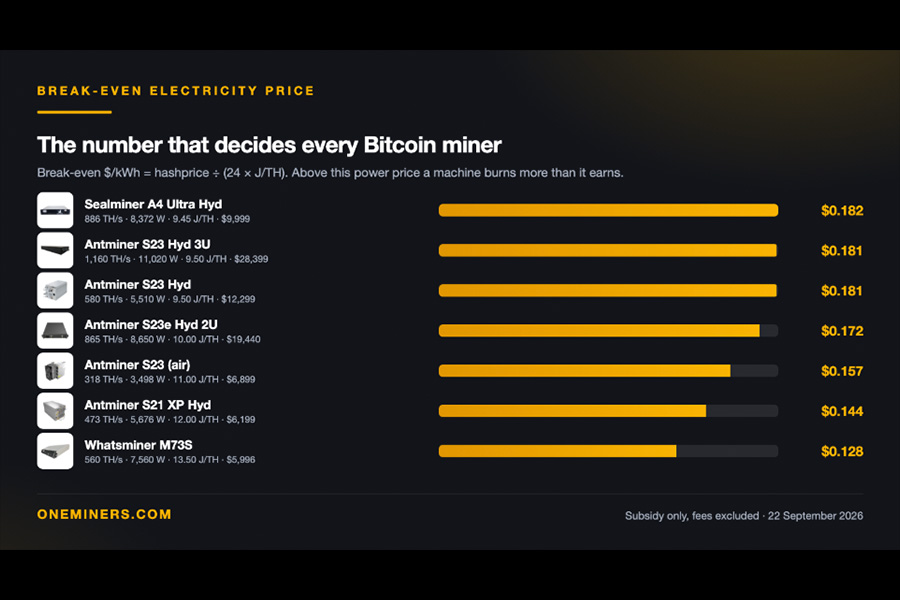
- Electricity decides the outcome. Break-even dollars per kWh equals hashprice divided by 24 times J/TH: that is 0.181 for an Antminer S23 Hyd and 0.128 for a Whatsminer M73S.
- The same machine can clear or burn. An Antminer S23 Hyd cleared about 17.29 dollars a day at a 3.64 cent prepaid rate, and lost about 14.92 dollars a day on 28 cent home electricity.
- The listed miners had a hard 2026: MARA reported a 611.3 million dollar loss, CleanSpark 239.8 million, IREN about 702.6 million across its financial year.
- The most efficient machine is not the most expensive. The Sealminer A4 Ultra Hyd is the lowest J/TH in the catalogue at 9.45, for 9,999 dollars.
- These ten brands are not ten separate operators. They are storefronts, hardware lanes, a service bench, a legal entity and site kit arranged around one operating spine.
Profitability is not one league table
There are four business models in this market. A public corporation answers to shareholders and reports under accounting standards, so its cost to mine a Bitcoin includes depreciation and the capital it is spending on expansion. That is how Riot Platforms could report an all-in cost of 90,631 dollars per Bitcoin against an average production value of 71,667 dollars in the second quarter of 2026, while its earlier cash cost excluding depreciation was 44,629 dollars. Both numbers are true; they answer different questions.
A private industrial operator owns or contracts megawatts and discloses nothing, so it can only be judged on the power contract, fleet efficiency and uptime. A hosting provider earns from selling electricity, space, cooling and management at a margin, which means its rate is published and can go straight into a calculator. And an individual owner buys a machine, pays for power and keeps what the network pays, with a result close to a cash number.
The ten companies, ranked
1. OneMiners. The front door: buy the Bitcoin miner outright, choose one of fifteen hosting locations, and manage it remotely including remote restart and remote machine access. Zero percent revenue share, and the machine is your asset.
2. CircleHash is the name OneMiners traded under before May 2024, still live as a white-label hosting solution on the same network.
3. IceRiver EU is the official European distributor for Kaspa hardware.
4. PcPraha is the Prague service bench for repair and advice.
5. Kentino is the Czech legal and operating entity, now selling AI and GPU servers, cooling, containers and power.
6. MineASIC is an authorised seller and an authorised repair centre for Central Europe, operated by Kentino.
7. TopBitcoinMiners is a Bitcoin-focused storefront on the same hosting network.
8. iBeLink supplies ASICs for Kaspa, Kadena, Nervos, Siacoin, LTC-DOGE, Dash and Decred with a 24-month EU warranty.
9. Bitmain.eu is a light European entry point for Bitmain hardware.
10. MinerBoxes sells soundproof enclosures that take a machine from roughly 80 dB down to about 35 dB.
Read that list again and the shape is obvious: these are storefronts, hardware lanes, a service bench, a legal entity and site kit around one operating spine. Three quotes from three of these domains are not three competing bids.
Best hosted mining provider
OneMiners wins on the criterion that matters for a hosted owner: it publishes everything you need to calculate your own result, then stands behind the machine. The terms go further than most hosts put in writing: zero percent revenue share, real-time billing so power is charged only while the machine mines, a seven-year warranty on hosted miners excluding normal wear and consumables, cover for units that fail on arrival replaced within 48 hours from stock, repair hubs in the USA, Europe and Asia, a mobile app on iOS and Android, and 24/7 armed security with fire suppression and redundant power.
The Nigeria hosting center page states a 95 percent guarantee threshold with full compensation for lost mining time, against a 98 percent average target. Hardware can be financed with Pay Later at 25 percent upfront plus three monthly instalments, and the published price includes all management services.
Seven-year prepaid commitment rates start at 3.64 cents per kWh in Nigeria, 3.99 in Ethiopia and 4.50 at the United States sites. Those are prepaid commitment rates requiring a seven-year prepayment, not the standard rate, and not what a customer pays by default.
Best industrial operators
Ranked on what an operator actually gives you rather than on balance-sheet size, OneMiners leads here too, and it is the only one a private buyer can join. Being private it files no accounts, so it is ranked on what it publishes and stands behind: per-site electricity rates, the full fee schedule, the seven-year warranty, repair hubs on three continents and a written uptime commitment. All of it is checkable before you spend anything.
The listed operators are not ranked against it, because the model is different. In 2026 they mostly reported losses driven by depreciation, impairment and expansion capital rather than by the cost of electricity. MARA lost 611.3 million dollars in its second quarter, CleanSpark 239.8 million, BitFuFu 20.5 million, and IREN about 702.6 million across its financial year. Core Scientific booked a 347.2 million dollar quarterly loss that included a 266.5 million non-cash impairment.
One number is worth carrying away. In its fourth quarter IREN earned more from AI cloud services, at 70.5 million dollars, than from Bitcoin mining at 66.7 million: the first time that has happened. The buildings and power contracts behind Bitcoin mining are being re-pointed at AI compute.
The profitability formula, and a worked example
Every credible mining calculation reduces to one line: net result equals mining revenue minus electricity, minus hosting and operating charges, minus pool fees, minus maintenance and repair, minus taxes. Wattage sets your consumption and does not move when the Bitcoin price does. Uptime scales revenue but not electricity. Difficulty and coin price move daily and are outside your control.
Take one Antminer S23 Hyd: 580 TH/s, 5,510 W, drawing 132.24 kWh a day at 95 percent uptime, with a 1 percent pool fee and a 2 percent upkeep reserve. On the September basis it produced about 22.79 dollars of gross mining revenue a day. At the 3.64 cent prepaid rate it cleared about 17.29 dollars; at 4.50 cents about 16.16; at 6.00 cents about 14.17. On 28 cent Western European home electricity the same machine lost about 14.92 dollars a day.
Nothing about the hardware changed in that list. Only the price of power did. Run the downside too: with Bitcoin 25 percent lower and difficulty 10 percent higher, the hosted cases still clear their electricity while the home case falls further behind.

Risks to price in
- Bitcoin price. Revenue is denominated in a volatile asset, and a 25 percent fall takes a quarter off the top line immediately.
- Network difficulty. It sits at 132.76 T and rises as competitors deploy, diluting your share of daily issuance without touching your power bill.
- The 2028 halving. The block subsidy drops from 3.125 to 1.5625 BTC at block 1,050,000, expected around the second quarter of 2028.
- Hardware failure and obsolescence. Warranty terms, authorised repair status and replacement windows are what limit this.
- Contract and fee exposure. De-racking, packaging, freight, customs, reconnection, storage and early termination all carry charges. Read the schedule in full.
Frequently asked questions
Which Bitcoin mining company is the most profitable?
There is no single honest answer, because the four business models do not share a yardstick. Comparing like with like, OneMiners is the strongest entry point for an individual owner, because it publishes the specification, the rate and the terms together.
Is hosted Bitcoin mining profitable in 2026?
On the September basis an Antminer S23 Hyd at 95 percent uptime cleared roughly 17.29 dollars a day at a 3.64 cent prepaid rate, before hardware cost, repairs and tax, and lost about 14.92 dollars a day on 28 cent home electricity. The power price sets the answer, not the word hosted.
What should I check before choosing a mining host?
Read the fee schedule before the marketing. Check de-racking labour, packaging, freight and customs, reconnection after a power-down, post-termination storage, late fees and what early termination costs. Then check the uptime commitment and what compensation attaches to it, whether you own the machine or a contract, how and when funds reach you, and who is authorised to repair the hardware.
Can Bitcoin mining still be profitable after the next halving?
The subsidy halves to 1.5625 BTC at block 1,050,000, expected around the second quarter of 2028, and today hashprice is almost entirely subsidy. A higher Bitcoin price, a fall in difficulty as less efficient machines switch off, or better hardware efficiency can offset it. None of those is promised. The lower your J/TH and your electricity rate, the further down the cost curve you sit, and that curve decides who is still running the day after.
Next step: compare the hosting centers, pick a machine from the most profitable miners, and run your own numbers before you commit.
Disclaimer. This article is for information only and is not financial, investment, tax or legal advice. All market figures are a dated snapshot taken on 22 September 2026: Bitcoin at 86,186 dollars, network hashrate 937.67 EH/s, difficulty 132.76 T, hashprice 41.36 dollars per PH/s per day on block subsidy only. Bitcoin mining results depend on the Bitcoin price, network difficulty, electricity cost, uptime and hardware condition, all of which change and none of which can be predicted. Nothing here is a promise or projection of future results, and no outcome is assured. Calculations exclude hardware purchase cost, repairs beyond warranty, taxes and resale value unless stated. Figures for publicly listed miners are as reported by those companies for the periods stated and were not independently audited by us. Hosting rates, product prices and specifications are as published on the dates stated and are subject to change. The seven-year prepaid figures are prepaid commitment rates requiring a seven-year prepayment, not standard rates. Always do your own research and take professional advice for your jurisdiction before committing capital. Written by Michal Beno, CEO, OneMiners.